Forensic Document Examination
Scientific analysis of documents, inks and substrates to assess their authenticity and recover information that is not visible.
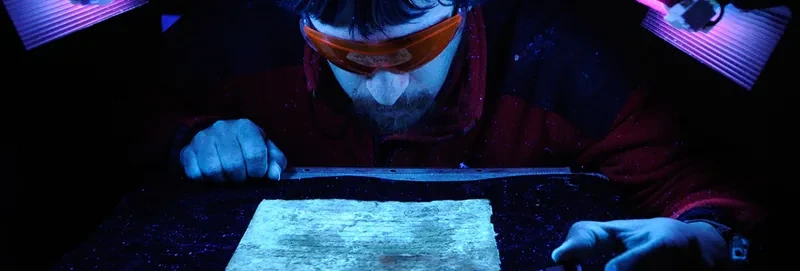
Forensic document examination is the scientific study of modern documents to determine their authenticity or falsification, or to restore their legibility.
A discipline that examines documents and their constituent elements: cellulose, cotton or polymer substrates, printing inks, stamps, etc. A wide range of analytical techniques is used, from conventional high-resolution and macro photography to imaging in bands invisible to the human eye, such as ultraviolet or infrared reflectography, and even fluorescence techniques, particularly infrared fluorescence. Similarly, multispectral capture and analysis, together with remote sensing techniques, provide an excellent means of extracting information from documents containing multiple inks or showing significant deterioration, such as inks faded through dissolution or ageing, or removed by chemical processes. These techniques can sometimes even be used on burned documents.
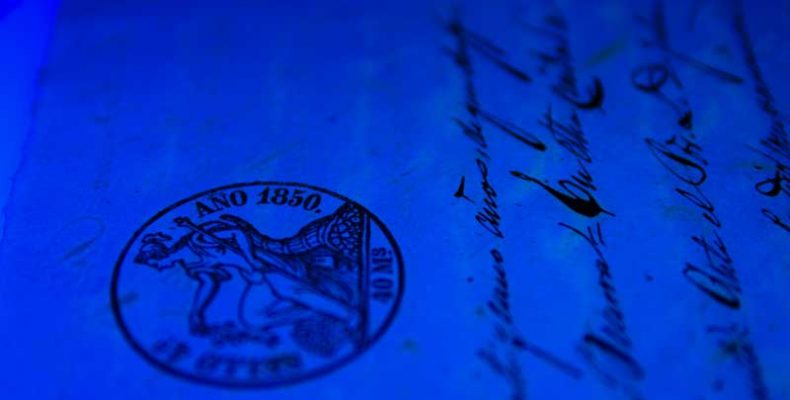
Our forensic document examination techniques are heavily inspired by modern methods used to interpret and study images captured by satellites or aircraft, as well as techniques derived from the study of artworks that have undergone significant alteration or modification over time.
For us, following a scientific method is a fundamental part of our work. All our work is supported by extensive scientific literature, and we use tools developed in-house, with calculations and algorithms always based on open-source code. These methods make our work fully reproducible and open to scrutiny by other researchers. This is a clear advantage if our findings are challenged at trial, should the matter proceed to court.
If you have any questions or legal issues, or need a technical report or expert assessment, please do not hesitate to contact us.