Forensic Document Examination
Faded inks, alterations and details invisible to the naked eye. Discover how the scientific examination of documents helps assess their authenticity and recover information.
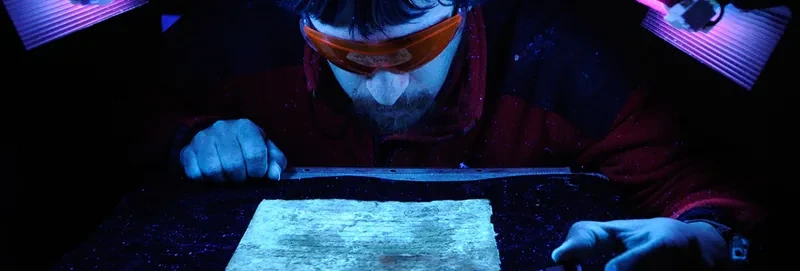
Forensic document examination is the scientific study of modern documents to determine their authenticity or falsification, or to restore their legibility.
What is examined in a document
This discipline studies documents and their constituent elements: cellulose, cotton or polymer substrates, printing inks, stamps, etc. It uses multiple analytical techniques, ranging from conventional high-resolution and macro photography to imaging in spectral bands invisible to the human eye, such as ultraviolet or infrared reflectography, and even fluorescence techniques, particularly infrared fluorescence. Similarly, multispectral capture and analysis, together with remote sensing techniques, provide an excellent strategy for extracting information from documents containing multiple inks or with significant deterioration, such as inks faded by dissolution or ageing, or removed by chemical processes. In some cases, these techniques can even be applied to burned documents.
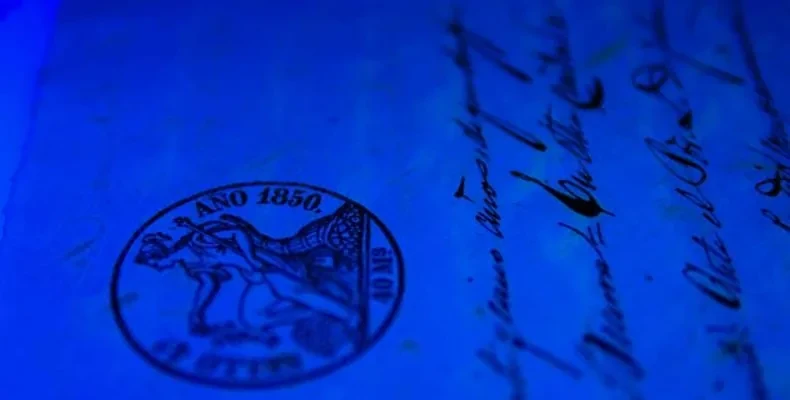
Multispectral capture and working method
Our techniques in forensic document examination are strongly inspired by modern techniques used to interpret and study images captured by satellites or aircraft, as well as techniques drawn from the study of artworks that have undergone significant deterioration or changes over time.
For us, adherence to a scientific method is a fundamental part of the work. All our work is supported by extensive scientific literature, and we use tools developed in-house, with calculations and algorithms always based on open-source code. The methodology, parameters and transformations must be documented to allow review by other researchers and define the scope of the conclusions.
Is the physical document required?
It depends on the question. A digital copy may be suitable for an initial assessment of visible elements, but it does not preserve all the properties of the substrate or allow it to be re-examined under different lighting. Before proceeding, it is advisable to indicate whether the original exists, how it has been preserved and what copies are available.
What results can be obtained and their limitations
The examination can help recover legibility or distinguish differences in the responses of inks and areas of the document. The result depends on the materials, their condition and the procedure available. A visual difference requires interpretation: on its own, it is not sufficient to date an ink, attribute authorship or establish forgery.
If the enquiry concerns the digital file or possible editing, see also forensic image analysis. The forensic photography provides controlled documentation of the details being examined. Contact AEICF to describe the material and the question you need to investigate.
Inquire about Forensic Document Examination ↗
Explore other specialties
All scientific and forensic imaging specialties · Meet AEICF members