
Forensic Photography
The precision of a photograph can be decisive in examining evidence. Learn how impressions, traces and objects are documented through controlled, reproducible image capture.
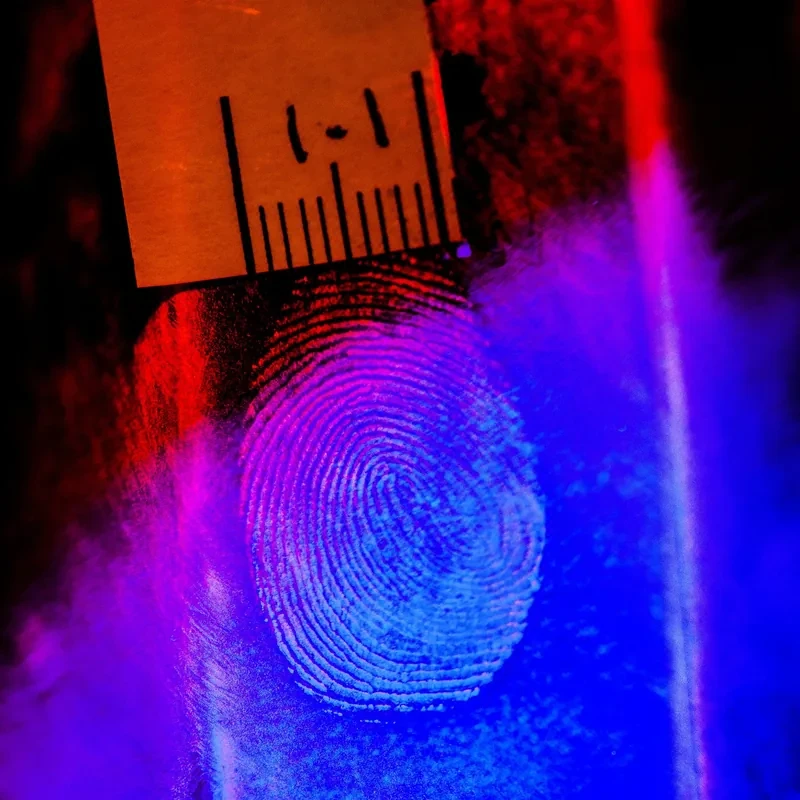
Photographing evidence is one of the most common tasks in forensic investigation.
Evidence capture and documentation
Forensic photography documents traces, marks, objects and scenes using a justified capture and processing method. The report must make it possible to understand how each image was obtained, what transformations it underwent and what limitations affect its interpretation.
Geometric accuracy and colour reproduction
The choice of lighting, scale and color references depends on the question being investigated. Geometric accuracy and color fidelity must be assessed in light of the capture conditions, rather than assumed.
The objective is to extract documented colorimetric information (intensity or hue in fluid stains, marks or bodily traces such as bruises, etc.). Our philosophy is the accurate transfer of colorimetric and spatial information between the scene or physical reality and the digital image representing that scene or object.
Non-visible imaging and multispectral analysis
Every evidence documentation project is accompanied by a detailed report specifying the accuracy thresholds of our images, describing the capture methodology used and listing the scientific references we rely on. When photographing certain evidence, such as ignition residues or physiological fluid residues, conventional RGB photography is supplemented with non-visible imaging techniques, such as UV and IR reflectography or fluorescence imaging, as well as multispectral capture and analysis techniques. This allows us to distinguish compounds that behave similarly in the visible spectrum but can be differentiated through non-visible band imaging or multispectral analysis.
Applications of forensic photography
- Characterisation of ignition residues (gunpowder, soot, etc.).
- Photography and characterisation of evidence.
- Photography and analysis of works of art and cultural assets.
- Document digitisation.
What to preserve before requesting an examination
Preserve the original files and any copies received, identify their source and avoid overwriting them when editing or forwarding them. Describe what needs to be examined and any known interventions. If the object or scene is available, indicate this so that controlled image capture can be considered.
Scope and limitations of the results
An image may show differences in the responses of materials, but those differences alone do not identify their composition. Likewise, the integrity of a file does not prove the truthfulness of what it depicts. Conclusions must address the question being investigated and explain the limitations of the material.
If the image already exists and the question concerns its origin or possible modifications, consult the specialty of forensic image analysis. To examine a written document, consult forensic document examination. You can submit your inquiry to the association.
Technical reference
SWGDE: best practices for maintaining image integrity, document 17-I-001-1.1. Preserving the file and documenting the work make it possible to review the operations performed.
Enquire about forensic photography ↗
Explore other specialties
All scientific and forensic imaging specialties · Meet AEICF members